From Paper to AI: The Evolution of Document Management Systems
The evolution of document management isn't just about moving from paper to AI; it's about solving successive constraints. Discover the five eras of document management, identify where your organization stands, and learn how to prepare your systems for true AI comprehension.
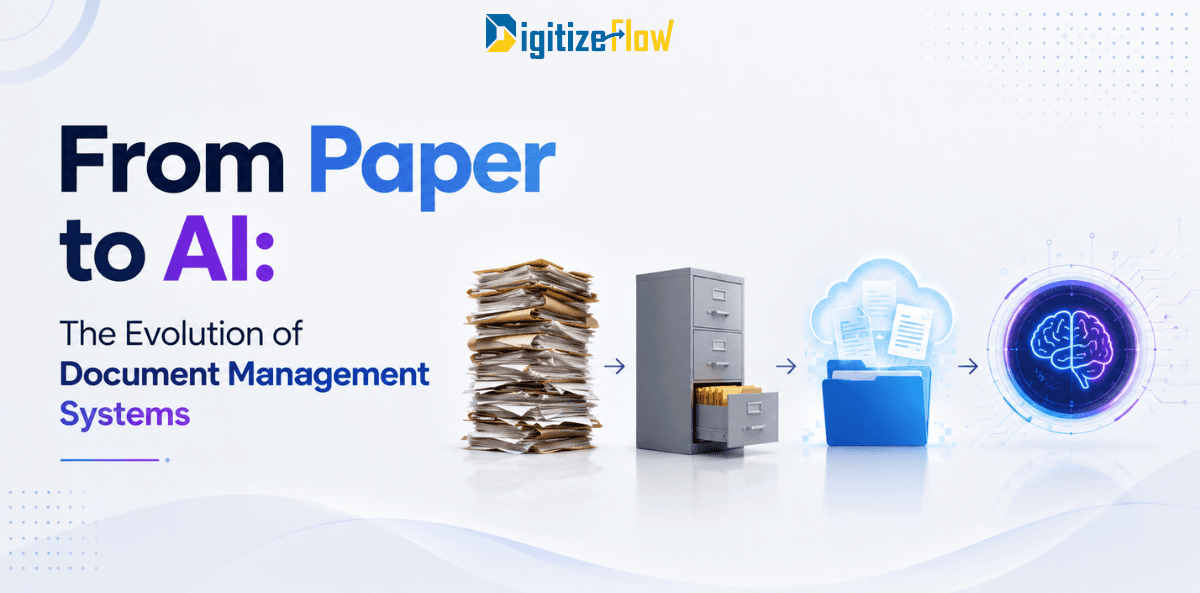
The evolution of document management is usually presented as a progress narrative: paper was bad, digital was better, cloud was better still, AI is best of all.
That version is comfortable and not very useful. A more accurate reading is that each generation solved the constraint of the one before it and introduced a new constraint of its own. Understanding which constraint you are currently living with is far more practical than knowing which decade you are notionally in, because it tells you what to fix next.
Five eras, each defined by the question it answered and the problem it left behind.
Era one, paper, and the question "where is the file?"
For most of commercial history, document management meant physical custody. The filing cabinet, the registry clerk, the numbering convention written inside the cupboard door, the outgoing register that recorded who borrowed which file.
It is easy to be dismissive about this era, and it is worth not being. Paper systems had properties that took decades to reproduce digitally. A document had exactly one authoritative copy. Possession was visible. Handing a file to someone was an auditable act. A good registry clerk was a search engine with judgement.
The constraint it could not escape: a document could be in only one place, available to one person, and a fire, a flood or a misfiled folder was permanent. Scale was bounded by physical space and by how many people could stand in front of the same cabinet.
Worth noting that this era has not actually ended in most organizations. It survives in the signed originals in the storeroom, the stamped approvals in the contracts drawer, and the printed protocol taped inside the cupboard door.
Era two, digitization, and the arrival of the digital pile
The scanner and the shared drive answered the first constraint directly. Documents became copies without limit, available to many people at once, backed up, and no longer destroyed by a burst pipe.
This era delivered a genuine and enormous win, and then produced a very specific disappointment, which is still the single most common complaint we hear in discovery meetings: the organization digitized its archive and still cannot find anything.
The reason is that scanning converts a physical pile into a digital pile. The folder tree inherits the filing cabinet's logic, often with less discipline, because creating a new folder costs nothing and nobody enforces the naming convention. Fifteen levels deep, four versions of the same contract, no indication which is current.
The constraint it created: location was solved, findability was not. Storage became cheap and structure became optional, and the two together produce an estate that grows faster than anyone's ability to describe it.
A large share of organizations in the region are still here, and the honest observation is that era two without era three is in some ways worse than paper. The registry clerk knew where things were. A shared drive does not.
Era three, the structured DMS, and the arrival of control
The third era brought the ideas that still define the discipline: metadata rather than folder paths, controlled versioning with an approved state, workflow for review and approval, retention and disposition rules, and an audit trail of who did what.
This is where document management became a system of control rather than a place to put files. It is what makes an accreditation body satisfied, a regulator comfortable and a court case defensible. Everything built since has been layered on top of these concepts rather than replacing them.
The constraints it created were three, and they are the reason the next era happened. Cost, because these platforms were expensive to licence and heavy to implement. Rigidity, because the configuration reflected the organization at the moment of implementation and aged badly. And isolation, because the DMS sat apart from where people actually worked, which meant adoption had to be enforced rather than earned.
That last one is decisive. A system people must leave their working environment to use is a system people route around.
Era four, cloud and collaboration, and the arrival of sprawl
The cloud era answered cost, access and isolation at the same time. Document management moved into the environment people already inhabited: the file opens in the application, co-authoring replaces version juggling, access works from anywhere without a VPN, and the capability arrives inside a licence the organization already holds.
It also changed who builds. Departments can now create their own sites, libraries and automated processes without a project, which is the single largest unlock of the last decade and also the source of the era's characteristic problem.
The constraint it created: governance debt. Thousands of sites, inconsistent metadata, permissions granted ad hoc and never reviewed, content duplicated across team sites, chats and personal storage. Nothing is lost, exactly, but nothing is authoritative either.
The irony is precise. Era two created a pile because structure was optional. Era four recreated the pile at ten times the scale because creation became frictionless.
Era five, AI, and the arrival of comprehension
Which brings us to now, and to a genuine discontinuity rather than an incremental improvement.
Every previous era treated a document as an object to be stored, moved, versioned and permissioned. The system knew where a document was and who could open it, and knew nothing whatsoever about what it said. All understanding lived with the human who opened it.
That is what changed. The current generation of systems can read unstructured documents and extract structured values without a trained template for each layout, classify and route content by what it contains, insert a reasoning step inside an otherwise deterministic workflow, and answer a question across a body of documents rather than returning a list of files to open.
The practical difference is a change of question. For fifty years the question a document system answered was "where is the document?" The question now is "what does our documentation say about this?" Those are not the same capability, and the second one is what people have always actually wanted.
The constraints this era creates are already visible, and they are the reason the next few years of this discipline will be about discipline rather than capability.
Provenance, because an answer without a traceable source is not usable for anything consequential. Accuracy, because a confident wrong answer is more damaging than no answer. Permissions, because assistive AI surfaces content based on what exists and what the asker may see, which turns over-sharing from an untidiness problem into a confidentiality one. And non-determinism, because a process whose output varies between runs cannot be audited, which means reasoning must stay upstream of commitments rather than inside them.
The pattern worth taking away
Read the five eras together and a pattern emerges that is more useful than the chronology.
Each era's value depends on the previous eras having been done. This is not a ladder you can jump up.
Extraction produces structured values, which are only useful if there is a metadata model to put them in, which is era three. Classification routes content, which only helps if there is a workflow to route it into, which is era three again. Answering questions across your documentation requires that the documentation be current, deduplicated and correctly permissioned, which is era four governance applied properly.
Hence the single most common failure of 2026: an organization still living in era two, with a shared drive and no structure, buying an AI capability and expecting it to compensate. It does not compensate. It reads the pile faithfully, finds four versions of the policy, and answers from whichever one it encountered, with complete confidence and no indication that the other three exist.
The organizations getting disproportionate value from AI right now are, almost without exception, the ones that did the unglamorous work of eras three and four first. Their reward is that the AI layer required no new project at all. It simply started working on content that was already structured.
Locating yourself honestly
Three questions place you more accurately than any maturity model.
Can you produce the current approved version of a given policy or contract in under a minute, and be certain it is current? If no, you are in era two regardless of what software you own.
Does your system know what kind of document each item is, who owns it, and when it must be reviewed? If no, you have storage, not document management, and era five will have nothing to stand on.
If someone asked an AI assistant a question about your policies today, would you be comfortable with the answer being acted on? If the honest response is a wince, the fix is not a better model. It is archiving the duplicates and auditing the permissions.
What this means in practice
The sequence has not changed, even though the destination has.
Structure first: document types, metadata, ownership, retention. Then control: versioning with an approval state, workflow, audit. Then hygiene: archive the superseded, deduplicate, fix permissions. Then intelligence, which at that point is largely a matter of switching on capability over content that is already fit to be read.
What has changed is the payoff for doing it. Five years ago, good information architecture bought you reliable search and a smoother audit. Today it buys you those things plus an organization that can ask questions of its own documentation and trust the answers. That is a materially larger prize for the same work, which is the most compelling argument for doing the work that this field has had in a long time.
The evolution from paper to AI was never really about the technology of storage. It was a slow progression from knowing where a document is, to knowing what it contains, to knowing what it means. Most organizations are somewhere in the middle of that sentence. The useful question is not which era you are in, but which constraint is currently costing you most.
Digitize Flow designs and builds document management systems on Microsoft 365 and SharePoint for enterprises across the Middle East, covering the full path from unstructured archives to AI-ready, governed document estates.
Book a document assessment and we will locate your organization honestly across these stages, identify the constraint costing you most, and give you a sequenced plan to the next one.
.png&w=3840&q=75)