Is Your Organization Ready for Enterprise Automation?
Discover the five true dimensions of enterprise automation readiness and a practical 90-day path to success, moving beyond the myth of needing perfect data and modern systems.
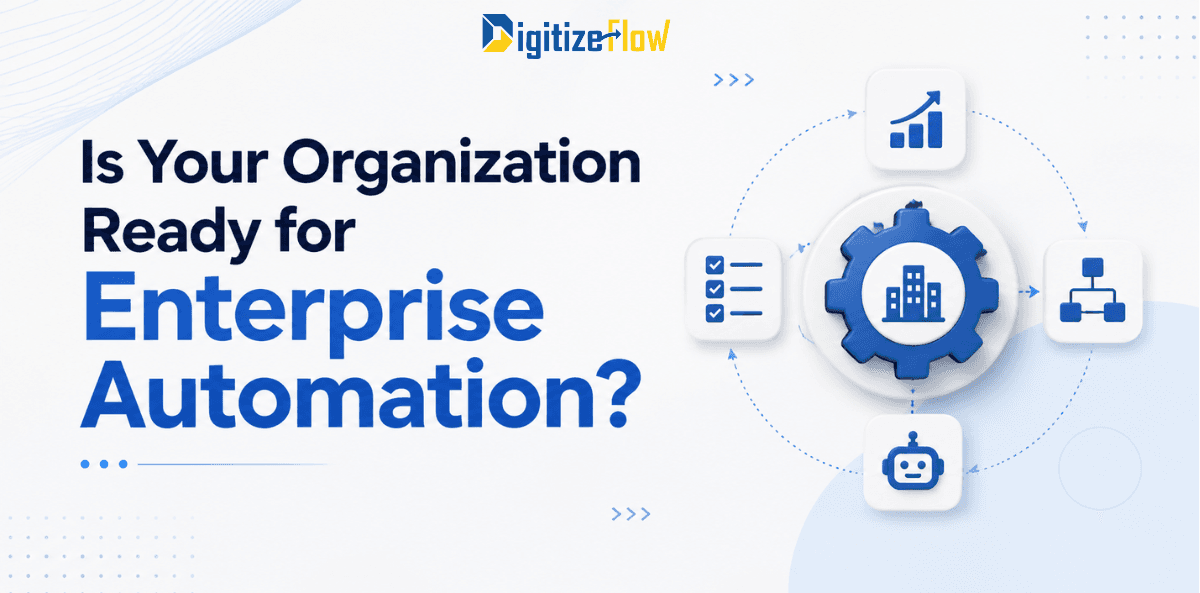
Are You Prepared for Enterprise-Wide Automation?
The question usually gets asked in one of two tones.
The first is defensive. Someone senior has seen a demo, a budget line has appeared, and a manager who will have to live with the result is looking for a legitimate reason to slow it down. "Are we ready?" means "please say no."
The second is genuine. A team has tried automation once, it did not take, and they want to understand why before spending again.
Both deserve the same answer, and it is not the one most consultancies give. Readiness is not a level of technological maturity that you either possess or lack. It is a small set of organizational conditions, most of which have nothing to do with software, and almost all of which can be created in a quarter if someone decides to create them.
This article is about identifying which of those conditions you are missing, because that is a far more useful question than whether you are ready.
The readiness myth
The common assumption is that automation readiness looks like this: modern systems, clean data, documented processes, an in-house technical team, and a completed digital strategy.
Organizations that wait for that state never automate anything. It does not arrive on its own, and several items on that list are actually outputs of automation programmes rather than inputs to them. Documentation gets written properly for the first time when someone has to automate a process. Data quality improves when a system starts refusing bad entries.
Meanwhile, the organizations that succeed usually start from an unglamorous position: a few good systems, a lot of manual work, and one process that everybody agrees is broken.
The real predictors of success are different, and there are five of them.
Readiness dimension one, process clarity
The diagnostic question: can two people who run the same process independently draw the same diagram of it?
Not "is it documented." Documentation is often a fiction agreed on years ago. The question is whether the people actually doing the work share one mental model of how it runs.
Where they do not, you will discover it in the worst possible way: three weeks into the build, when the Cairo office explains that they have always done step four differently and everyone assumed that was normal.
This is the most common blocker, and it is also the least serious, because resolving it takes days rather than months. Get the people in a room, walk the process end to end, and write down the disagreements. The disagreements are the deliverable. A process nobody can describe consistently is not ready to be automated, but it is ready to be mapped, and mapping it is a two-day exercise, not a transformation programme.
Readiness dimension two, decision rights
The diagnostic question: for the process you want to automate, can you name the person who is allowed to change the rules?
Automation forces decisions into the open. What is the approval threshold, exactly? Who approves when the approver is on leave? What happens when a request sits for ten days? In manual processes these questions stay comfortably unresolved, because a human absorbs them case by case.
The moment you build a workflow, every one of those questions demands a concrete answer. And if no single person has the authority to give it, your project stalls in a committee.
This is the dimension that most often separates organizations that ship from organizations that discuss. It has nothing to do with technology and everything to do with governance. If the answer to the diagnostic question involves more than two names, fix that before writing any requirements.
Readiness dimension three, data you are willing to act on
The diagnostic question: when the system produces a number, will management act on it, or check it first?
Perfect data is not required. Trusted data is. There is a large difference.
Automation makes data consequential. A workflow that routes based on a department field will route wrongly if the department field is wrong, and unlike a human, it will do so consistently and at speed. The failure is not that automation needs clean data. It is that automation exposes dirty data immediately and publicly.
You do not need to fix everything. You need to know which specific fields your first automated process depends on, verify those, and put validation in place so they stay correct going forward. That is a scoped task measured in days, not an enterprise data quality initiative.
Readiness dimension four, ownership after go-live
The diagnostic question: six months after launch, when a rule changes, who changes it?
This is the dimension organizations think about least and suffer from most.
Automation is not a project that finishes. Approval thresholds change, people move, the business reorganizes, a new document type appears. If there is no named owner with the access, the skills and the time to make those changes, the system slowly drifts away from how the business actually works. People start working around it. Within eighteen months it becomes the legacy system that the next consultant is asked to replace.
The answer does not need to be a large team. One capable person with clear ownership and a few days a month is often enough for a first wave. What is fatal is the answer "the vendor" or, worse, silence.
Readiness dimension five, appetite for the awkward middle
The diagnostic question: can your organization tolerate six weeks of a process being worse before it gets better?
Every automation goes through a period where the old way has been disrupted and the new way is not yet smooth. People are learning, edge cases are surfacing, and someone will complain that the manual process was faster.
That complaint is usually correct in the short term, and it is the moment where weak programmes get quietly abandoned. Organizations that get through it are the ones where a sponsor said in advance that this phase would happen, so it reads as expected rather than as failure.
If your organization abandons initiatives at the first friction, you are not blocked from automating. You are blocked from automating something big. Start with something small enough that the awkward middle lasts two weeks.
Scoring yourself honestly
Take the five questions above and answer each with yes, partly, or no. Do it about one specific process rather than about the organization in general, because readiness is not uniform. A company can be fully ready to automate procurement approvals and completely unready to automate anything touching HR.
Four or five clear yes answers. You are ready to build, now. The main risk is scope, not readiness. Pick one process, deliver it in eight to twelve weeks, and use it to establish the patterns you will reuse.
Two or three. This is where most organizations sit, and it is a normal starting position rather than a warning. Identify the specific gaps, spend three to four weeks closing them for one process only, then build. Do not attempt a broad programme from here.
Zero or one. Automation is not your first problem. Something more fundamental is unresolved: unclear ownership, an unstable organizational structure, or a process the business genuinely has not decided how it wants to run. Automating in this state builds a fast, expensive version of confusion. Fix the process first, on paper, with a human running it.
Signals you are being sold something you are not ready for
A few warning signs worth naming, because they turn up often.
The scope is the whole department. Any proposal to automate an entire function in one programme should be split. Value arrives per process, and so does learning.
Nobody has quantified the current state. If the proposal contains no figure for how long the process takes today or how many exceptions it produces, there is nothing to measure success against, which means success will be declared rather than demonstrated.
The demonstration used clean sample data. Ask to see the process run against your real data, with your real exceptions. That is where every serious problem lives.
Governance is scheduled for phase two. Environment strategy, ownership, permissions and cost caps belong in phase one. Retrofitting governance across a live estate costs several times what building it in costs.
The word "AI" appears more often than the word "process." The technology is genuinely capable in 2026. It is still not a substitute for knowing what your process should do.
What actually predicts success
Having watched enough of these programmes, one factor outperforms all the others combined, and it is not budget, technical sophistication or executive sponsorship.
It is whether one named person inside the business, not in IT and not at the vendor, owns the outcome and wants it to work.
Every successful automation has this person. They answer the questions nobody else will answer, they make the awkward decisions about exceptions, they push their colleagues through the difficult six weeks, and they keep the system aligned to reality afterwards. Programmes with a strong owner survive weak technology. Programmes with excellent technology and no owner do not survive at all.
If you can identify that person for your target process, you are considerably more ready than a maturity assessment would suggest. If you cannot, finding them is your actual first task.
A ninety-day path from here
Weeks one to three, choose and map. Pick one process with a high volume of routine cases and a visible exception rate. Map it with the people who run it. Record how long it takes today and how many exceptions occur per week. Resolve the disagreements you find.
Weeks four to six, settle the rules and the ownership. Get concrete answers on thresholds, delegation, escalation and edge cases. Name the process owner and the person who will maintain the solution. Set up the environment and governance basics before any build starts.
Weeks seven to twelve, build, pilot, measure. Deliver the process for one team. Run it alongside the manual process briefly if the risk warrants it. Measure the same numbers you captured in week three.
At the end of that quarter you will not have a transformed organization. You will have something more useful: one working process, a set of patterns you can reuse, a team that has been through the awkward middle once, and a real number to take to whoever controls the budget for the next five processes.
That is what readiness looks like in practice. Not a state you achieve before starting, but the thing you build by starting somewhere small and finishing it properly.
Digitize Flow delivers enterprise automation on Microsoft Power Platform, SharePoint and Dynamics 365 for organizations across the Middle East, with a focus on document-heavy and approval-heavy processes.
Book a readiness assessment and we will run the five questions above against one of your real processes, map it with your team, and give you a costed view of what the first ninety days would deliver.