The Future of Document Management in the AI Era
Stop wasting hours searching for lost files. Learn how AI is turning broken document management into an automated, intelligent powerhouse, and what your enterprise must do to adapt
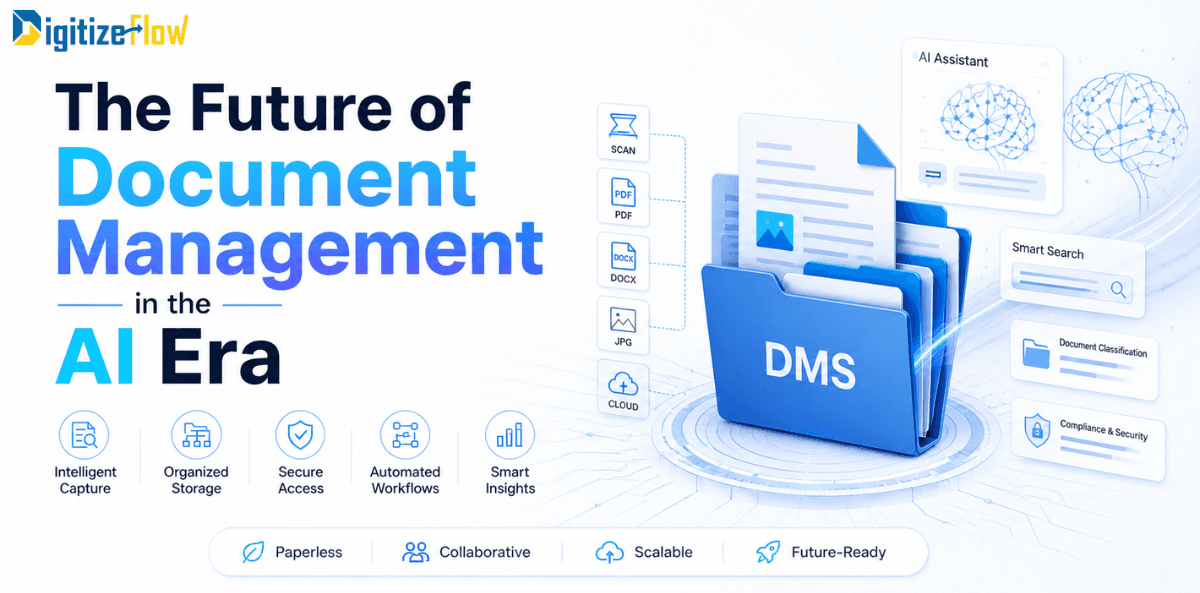
The Future of Document Management in the AI Era
Document management is undergoing its most significant transformation in decades. Here is what is changing, why it matters, and what enterprises need to do about it
For decades, enterprise document management meant organizing files into folders, applying naming conventions, and hoping employees would follow the rules. The honest reality is that most organizations have tolerated broken document management for years because fixing it seemed too difficult and the status quo seemed tolerable enough.
That calculation is changing rapidly. Artificial intelligence is not just making document management better. It is making the cost of poor document management significantly higher by creating a visible, measurable gap between organizations that manage content intelligently and those that do not. The enterprises that modernize their document management foundation now will have a structural advantage that compounds over time. Those that delay will find the gap increasingly difficult to close.
The Scale of the Problem AI Is Solving
Before exploring what AI-powered document management delivers, it is worth being precise about the problem it is solving. The numbers reveal why this is a business-critical priority rather than an IT housekeeping task:
28% of the average knowledge worker's week is spent searching for and managing documents (McKinsey Global Institute)
7.5 hours per week lost by employees who cannot find the information they need (IDC Research)
83% of employees report recreating documents that already exist because they could not find the original
$20,000 estimated annual cost per knowledge worker of time lost to poor information management
These numbers describe a problem that has been accepted as normal for so long that most organizations have stopped measuring it. AI-powered document management makes it measurable, addressable, and solvable in ways that manual approaches never could.
What AI Is Actually Changing About Document Management
The AI transformation of document management is not a single feature. It is a set of interconnected capabilities that, together, change the fundamental economics of how organizations handle content.
From Manual Tagging to Automatic Classification
Traditional document management relies on humans to apply metadata when they upload files. The result is inconsistency, gaps, and gradually degrading search quality as the volume of untagged or incorrectly tagged documents grows. AI changes this completely.
Microsoft Syntex, integrated directly into SharePoint, uses machine learning models trained on an organization's own documents to read incoming files, identify their type, extract key data fields, and apply metadata automatically. A contract uploaded to the system is classified as a contract, the counterparty name and expiry date are extracted, and the document is tagged and routed without any human input. The metadata quality is consistent from the first document to the millionth.
From Keyword Search to Semantic Understanding
Keyword search returns documents that contain the words you typed. Semantic search returns documents that are relevant to what you mean. This distinction is more significant than it sounds in practice.
When an employee searches for documents related to a supplier dispute, a semantic search engine surfaces relevant contracts, correspondence, and meeting notes even if none of those documents explicitly use the phrase "supplier dispute." Microsoft Copilot, integrated with SharePoint, brings this semantic capability to enterprise document search. Employees find what they need on the first search rather than the fifth, and they find documents they would never have thought to look for by keyword.
From Reactive Compliance to Proactive Governance
Document compliance in traditional systems is reactive. Retention policies are applied manually. Sensitive content is identified through periodic audits. Regulatory documentation is assembled by hand when it is needed.
AI-powered governance, delivered through Microsoft Purview and Syntex, makes compliance proactive. Sensitive content is identified and labeled automatically as it enters the system. Retention policies are applied based on content classification rather than file location. Documents approaching their retention period trigger review workflows automatically. The compliance burden shifts from a periodic manual task to a continuous automated process.
From Static Repositories to Intelligent Content Surfaces
The most significant shift in AI-era document management is the transition from repositories to intelligent surfaces. A traditional document management system is a place where content is stored. An AI-powered content environment is a system that actively brings relevant content to the people who need it.
Microsoft Copilot surfaces relevant documents in context: during a Teams meeting about a project, it can retrieve the latest project documents, summarize recent decisions, and identify action items from previous discussions. In SharePoint, it answers questions based on the content of the document library rather than requiring the employee to formulate a search query. The system becomes an active participant in knowledge work rather than a passive storage location.
Five Shifts That Define AI-Era Document Management
The transition from traditional to AI-powered document management can be understood as five fundamental shifts in how organizations relate to their content:
From storage to intelligence: Documents are no longer just stored. They are read, classified, and connected to workflows, analytics, and AI systems that act on their content.
From search to discovery: Employees no longer need to know what to search for. AI-powered discovery surfaces relevant content based on context, role, and current activity.
From manual governance to automated compliance: Retention, classification, and sensitivity labeling happen automatically at the point of content creation rather than as periodic administrative tasks.
From siloed content to connected knowledge: Documents in SharePoint, emails in Exchange, meeting recordings in Teams, and data in Dynamics are connected through Microsoft Graph into a unified knowledge environment that AI can navigate on behalf of the user.
From reactive IT to proactive business intelligence: Document management data, processed through Power BI, becomes an operational intelligence layer: what content is being created, by whom, at what volume, with what compliance status, and where the bottlenecks in document workflows are occurring.
What Organizations Need to Do Now
Understanding the direction of change is useful. Knowing what to do about it is more useful. For organizations operating within the Microsoft 365 ecosystem, the path to AI-era document management follows a clear sequence.
Establish the Foundation Before Adding AI
AI-powered document management performs in direct proportion to the quality of the content foundation it operates on. Organizations that deploy Copilot and Syntex on top of unstructured, poorly tagged, poorly governed SharePoint environments consistently report disappointing results. The AI cannot do its job well if the underlying data is disorganized.
The foundation work requires three things:
A well-designed information architecture with consistent metadata schemas and content types
Governance policies that define how content is created, named, tagged, retained, and disposed of
A migration strategy that brings existing content into the new environment with metadata applied, not as a raw file dump
Sequence AI Capability Adoption Deliberately
Organizations that try to deploy every AI document management capability simultaneously typically end up with shallow adoption across all of them. The more effective approach sequences capabilities based on organizational readiness and impact priority.
A practical sequence looks like this:
Start with Microsoft Syntex for automatic document classification on the highest-volume content types. This builds metadata quality rapidly and creates the foundation for everything that follows.
Add Copilot for SharePoint search and content discovery once the metadata foundation is established. The quality of Copilot's responses will be noticeably better on a well-tagged content library.
Integrate Power Automate to route AI-classified content through approval and lifecycle management workflows. The combination of automatic classification and automatic routing eliminates the most labor-intensive document handling tasks.
Build Power BI dashboards that surface document management intelligence: content volumes, compliance status, workflow performance, and search usage patterns. This operational visibility enables continuous improvement.
The organizations that will lead in AI-era document management are not necessarily those with the largest budgets or the most aggressive deployment timelines. They are those that build the foundation correctly and add AI capabilities on top of a structure designed to support them.
How Digitize Flow Helps Organizations Make the Transition?
The transition to AI-era document management is not a technology project that can be delegated to an IT team and declared complete at go-live. It is a business transformation that requires deep expertise in information architecture, governance design, change management, and the specific capabilities of SharePoint, Syntex, Copilot, and the broader Microsoft 365 ecosystem.
Digitize Flow works with enterprises through every stage of this transition. We begin with an assessment of the current document management environment: the existing content structure, metadata quality, governance gaps, and AI readiness. From that assessment, we build a prioritized roadmap that identifies the highest-impact improvements and sequences them in an order that generates early visible value while building the foundation for more advanced AI capabilities.
Our approach is built on a consistent observation: the organizations that capture the most value from AI-powered document management are those that treat the information architecture and governance work as the investment, and the AI tools as the return on that investment. Getting the sequence right is the difference between AI that transforms how the organization works and AI that sits unused on top of content that was never organized well enough to support it.
Frequently Asked Questions
Does AI-powered document management require replacing our existing SharePoint environment?
No. Microsoft Syntex, Copilot, and Purview are designed to be layered onto existing SharePoint Online environments. The transition to AI-powered document management typically begins with an assessment of the existing environment, followed by targeted improvements to information architecture and metadata quality, followed by the activation of AI capabilities on top of the improved foundation. Starting over is rarely necessary and almost never the most efficient path.
How long does it take to see measurable results from AI document management capabilities?
For well-governed SharePoint environments with strong metadata quality, organizations typically see measurable improvements in search accuracy and document retrieval time within four to six weeks of activating Copilot and Syntex. For organizations that need foundational work first, the timeline to measurable AI value is three to five months. The foundational work is not a delay in achieving value. It is what makes the value achievable and sustainable.
What is the most important thing an organization can do today to prepare for AI-era document management?
Audit your current SharePoint metadata quality. Identify the percentage of documents in your most important libraries that have complete, accurate metadata applied. If the number is below 70 percent, metadata quality improvement is the highest-leverage investment you can make in AI readiness. Every AI capability in the Microsoft 365 ecosystem performs better on well-tagged content. Improving metadata quality now is not just governance housekeeping. It is AI preparation.
.png&w=3840&q=75)