Why Most DMS Implementations Fail (And How to Fix It) ?
The failure rate of DMS implementations is not a technology problem; it is a strategy problem. Discover the top 6 reasons why DMS projects fail and the strategic steps required to fix them.
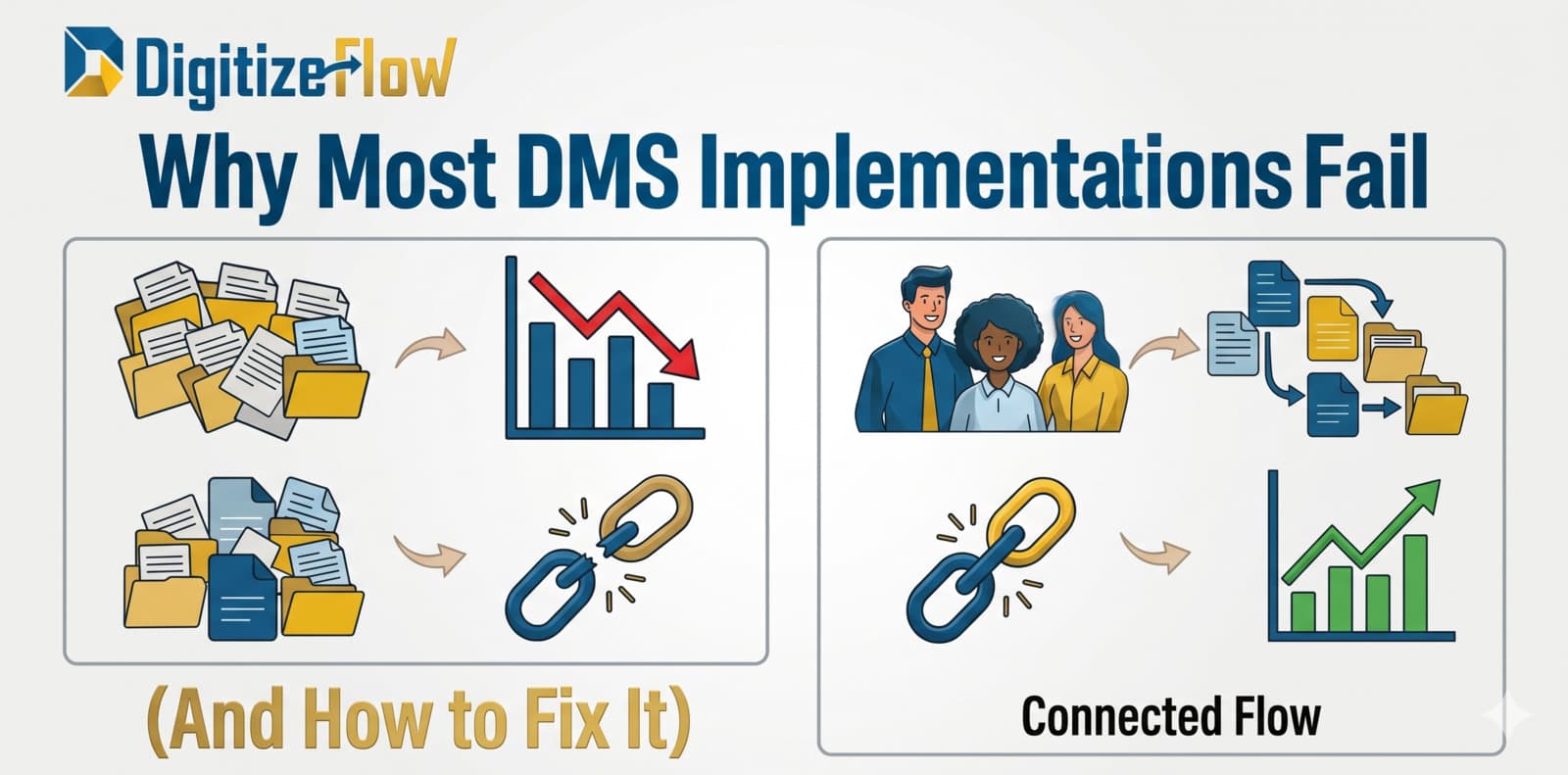
The problem is almost never the software It is everything that happens before and after it
Enterprises spend significant budget on Document Management Systems every year.
They evaluate vendors, negotiate contracts, run implementation projects, and announce go-live dates. And then, far too often, the system is quietly abandoned or worse, it limps along as a glorified file server while the real work continues to happen on email and shared drives.
The failure rate of DMS implementations is not a technology problem. It is a strategy problem.
The software works. What fails is the thinking that surrounds it the decisions made before the first configuration screen is opened, and the investment not made after the last training session is delivered.
The Six Reasons DMS Implementations Fail
1. The Project Starts With the Software, Not the Problem
The most common and most consequential mistake in DMS implementation is beginning with the technology selection. Organizations evaluate platforms, compare features, and negotiate licensing before they have a clear picture of what problem they are actually trying to solve.
A DMS that is selected before the business processes it will support are clearly documented is a system built on assumptions. Those assumptions are almost always wrong in ways that only become visible after go-live when users discover that the folder structure does not reflect how they actually work, that the metadata fields do not capture what the business needs to track, and that the workflows automate a process that nobody follows in practice.
2. Information Architecture Is Treated as a Technical Decision
How a DMS is structured the site hierarchy, the metadata schema, the content types, the permission model is the most important decision in the entire implementation. It determines how findable documents are, how secure the system is, how scalable it becomes, and how much it costs to maintain.
In most failed implementations, this architecture is designed by the IT team based on technical defaults rather than by business stakeholders based on how the organization actually creates, uses, and retrieves documents. The result is a technically functional system that does not match how people think about their work and a system people do not intuitively understand will not be used.
3. Migration Is Treated as a Lift-and-Shift Operation
Organizations consistently underestimate what document migration actually requires. Moving files from a file server or a legacy system into a DMS is not a technical task it is a governance task. Before any content migrates, someone with business authority needs to decide:
• What content is current and should be migrated actively
• What content is historical and should be archived
• What content is obsolete and should be deleted
• How incoming content should be tagged in the new metadata structure
Organizations that skip this rationalization phase migrate their chaos into the new system. A DMS filled with poorly named, untagged, duplicate documents is not a Document Management System. It is an expensive shared drive.
4. Adoption Is Planned as an Event, Not a Process
The most reliable predictor of DMS failure is treating user adoption as a single event a training session on launch day rather than as an ongoing process that requires sustained investment.
People do not change ingrained working habits because they attended a two-hour training. They change habits when the new system is demonstrably easier than the old one, when their peers are using it, when their managers expect it, and when the friction of the old approach becomes greater than the friction of learning something new. Creating those conditions requires months of deliberate effort, not a go-live announcement.
5. Governance Is Left Until After Launch
A DMS without governance degrades. Without clear rules for how documents are named, how metadata is applied, who can create new document libraries, and how content is reviewed and archived, the system accumulates disorder at the same rate the organization generates content.
Six months after a governance-free go-live, the DMS looks like the file server it replaced just hosted differently. The organizations that maintain high-quality DMS environments are those that defined governance policies before launch and enforced them consistently afterward.
6. Success Is Never Measured
If an implementation does not define what success looks like before it begins, it cannot know whether it has succeeded or failed. Most DMS implementations are declared complete at go-live and never measured against business outcomes.
The metrics that matter are not technical. They are operational: average document retrieval time, compliance audit preparation time, version conflict incidents, employee satisfaction with document access, and time spent on manual document handling. Organizations that track these metrics before and after implementation have the evidence to optimize. Those that do not are flying blind.
What Successful DMS Implementations Do Differently
The organizations that get lasting value from their DMS investments share a consistent pattern of decisions. None of them are technically complex. All of them require organizational discipline.
1. They define the problem before selecting the platform. The vendor evaluation happens after the use cases, workflows, and governance requirements are documented not before.
2. They invest in information architecture as a strategic discipline. A senior business stakeholder owns the architecture decisions. IT governs the technical implementation of those decisions.
3. They rationalize content before migration. A content audit precedes the migration project. What migrates is the content the organization needs not everything that exists.
4. They build adoption plans that span at least ninety days post-launch. Champions are identified in each department. Feedback loops are established. The system is visibly supported by leadership.
5. They define governance policies on day one and enforce them consistently. Document naming conventions, metadata standards, library creation rules, and archival schedules are decided before go-live, not after problems emerge.
6. They measure outcomes and use the data to improve. Baseline metrics are established before implementation. Post-launch metrics are reviewed monthly. The system evolves in response to real usage patterns.
The Role of the Implementation Partner in Preventing Failure
One of the least discussed contributors to DMS implementation failure is the quality of the implementation partner and specifically, whether the partner's scope of work extends beyond the technical configuration.
A partner who delivers a configured DMS and hands it over at go-live has completed a technical project. A partner who delivers a configured DMS, a governance framework, a migration strategy, an adoption plan, and post-launch support has delivered a business outcome. The difference between these two engagements is the difference between a system that gets used and a system that gets abandoned.
At Digitize Flow, the most consistent observation across DMS engagements whether built on SharePoint, Microsoft Syntex, or broader Power Platform architecture is that the technical implementation is rarely where value is created or destroyed. Value is created in the discovery phase, where the real requirements surface. It is protected in the governance design, where the rules that keep the system healthy are established. And it is delivered in the adoption work, where the investment in configuration becomes visible to the people the system was built to serve.
Organizations that engage partners whose scope covers all three phases not just the build consistently report higher adoption, lower post-launch maintenance costs, and greater measurable return on their DMS investment.
The Honest Diagnosis
If your organization has already deployed a DMS that is underperforming, the path forward is not to replace the software. In the vast majority of cases, the platform is not the problem. The information architecture, the governance, and the adoption investment are.
A DMS remediation auditing the existing structure, rationalizing the content, rebuilding the governance framework, and re-engaging users is almost always faster and cheaper than starting over. And it addresses the actual causes of underperformance rather than repeating the same implementation mistakes with different software.
The question worth asking before any DMS investment new or remediation is not which platform to choose. It is whether the organization is prepared to make the non-technical investments that determine whether any platform succeeds. The technology is the easy part. It has always been the easy part.
Frequently Asked Questions
How do we know if our current DMS is failing or just underperforming?
The diagnostic is straightforward. Ask your employees how they find documents when they need them. If the answer involves searching email, asking a colleague, or navigating a folder structure by memory rather than by search or metadata filter, the system is failing at its core function. Measure how long it takes to locate a specific document version, prepare a compliance report, or onboard a new employee to the document environment. If those numbers are measured in hours rather than minutes, the system is underperforming regardless of how much was invested in deploying it.
What is the minimum governance framework a DMS needs to function well?
At minimum, a functional DMS governance framework covers four areas: document naming conventions that are consistently applied across all libraries, metadata standards that define which fields are mandatory and what values are acceptable, a library creation policy that prevents uncontrolled sprawl of new sites and document libraries, and an archival schedule that defines how long different document types are retained before review or deletion. These four elements, clearly defined and consistently enforced, prevent the majority of DMS degradation that organizations experience in the first twelve to eighteen months after launch.
How long does a DMS remediation typically take compared to a new implementation?
A focused DMS remediation covering content audit, architecture redesign, governance framework development, and user re-engagement typically takes six to ten weeks for a mid-size organization. A new implementation for the same organization, starting from a clean slate, takes ten to sixteen weeks. The remediation is faster because the organizational context, the existing content, and the user base are already in place. What changes is the structure around them, not the foundation.


.png&w=3840&q=75)